As agentic AI reshapes IT, Saudi organisations show strong confidence in governance while focusing on measurable returns, employee experience and the foundations required to scale
Riverbed, the leader in AIOps for observability, today announced the results of the Riverbed Global Survey on ‘The State of Autonomous IT Operations’. Artificial intelligence has crossed the threshold from experimentation into the IT operating model, with organisations accelerating efforts to operationalise AI and progress towards autonomous IT. As AI assumes a greater role in enterprise operations, the ability to understand, trust and govern it will become increasingly important.*
The Saudi findings from this new research indicate that organisations in the Kingdom are particularly alert to this requirement. More than half (54%) of Saudi respondents are extremely confident in their organisation’s AI governance and human-oversight capabilities, compared with 42% globally. At the same time, 93% agree that effective AI assurance, observability and governance will become a critical new IT domain to manage, while 77% report internal hesitation about allowing AI to make operational decisions without human approval.
The findings suggest that Saudi enterprises view governance as an enabler of AI adoption rather than a constraint. Establishing visibility into how AI performs and retaining appropriate human oversight will give organisations the confidence to expand automation while maintaining control over operational decisions.
“Riverbed’s new research shows that AI is becoming fundamental to how IT operates, as organizations look to use it to create more resilient, efficient and proactive environments,” said Jim Gargan, Chief Marketing Officer, at Riverbed. “The next phase of AI is not simply more automation, but AI that enterprises can understand, trust and govern. Riverbed is helping customers close these gaps with unified observability, trusted data, AI governance and intelligent automation, accelerating toward zero-disruption autonomous IT operations.”
Saudi organisations move from AI investment to execution
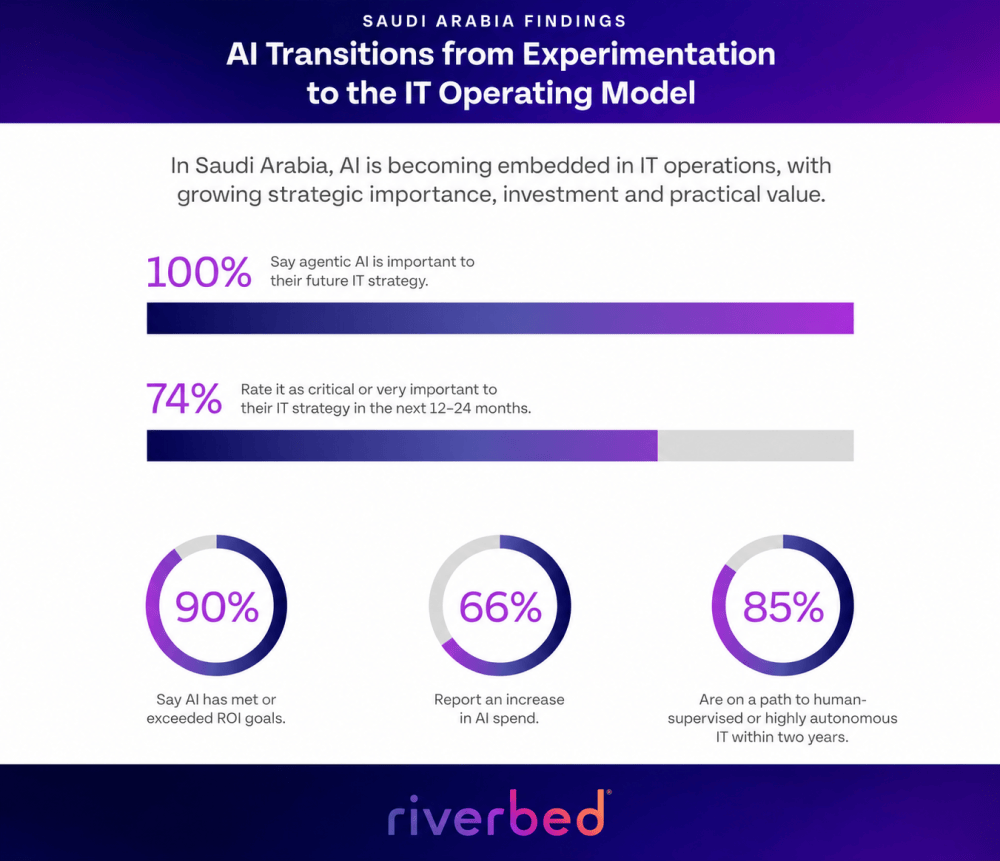
Saudi enterprises are increasing investment in AI and reporting measurable returns from their initiatives. Two-thirds (66%) of Saudi organisations increased their AI investment during the past year, while 90% say their AI initiatives have met or exceeded their original return-on-investment goals. Looking ahead, 85% want to progress to human-supervised or highly autonomous IT operations within the next two years.
These findings indicate that the conversation is shifting from whether organisations should adopt AI to how effectively they can operationalise it at scale. Continued success will depend on translating investment and ambition into more resilient, efficient and proactive IT operations.
Autonomous IT will be judged by the employee experience
Saudi organisations are already reporting strong capabilities in using AI to improve IT operations and reduce employee disruption. Forty-four percent say their IT operations teams are extremely effective at using AI to identify and resolve issues before employees notice a disruption, compared with 34% globally. In addition, 96% expect AI-powered operational intelligence to have at least a moderate impact on frontline IT and service-desk capabilities within the next two years, while 36% expect the service desk to shift from reactive support towards proactive prevention.
The findings suggest that the success of autonomous IT should not be measured simply by the number of processes automated or the volume of service-desk activity reduced. Its impact will increasingly be determined by whether organisations can anticipate problems, prevent disruption and provide employees with a consistently high-quality digital experience.
A unified operational foundation will be essential to scale
As organisations in Kingdom of Saudi Arabia progress towards more autonomous IT, unified visibility and simpler technology environments will become increasingly important. Almost all Saudi respondents (95%) consider multi-domain visibility at least somewhat important for successful AI-driven IT operations, but only 22% currently have fully unified visibility across networks, applications, endpoints and cloud environments. Encouragingly, 94% agree that tool consolidation can reduce operational friction, while 94% also agree that a unified platform can simplify problem identification and resolution.
Closing this gap will require organisations to consolidate fragmented tools, establish trusted and accessible data, and create unified visibility across their IT environments. These capabilities will give AI the operational context required to make reliable recommendations, support faster decisions and enable greater levels of autonomy.
“Saudi Arabia has built tremendous momentum around AI, supported by ambitious national programmes and organisations focused on translating innovation into measurable outcomes,” said Salman Ali, Senior Manager – Solution Engineering, GCC, at Riverbed. “The next stage will be defined by how effectively enterprises can govern AI and apply it to improve everyday operations. By unifying their data and observability capabilities, Saudi organisations can progress towards autonomous IT while maintaining appropriate human oversight, strengthening digital experiences and ensuring their AI investments deliver lasting business value.”
The findings point to a more operational phase of enterprise AI adoption in Saudi Arabia. As the Kingdom continues its digital transformation journey under Vision 2030, its organisations have an opportunity to accelerate human impact by building a globally competitive organization from the ground up to unlock new levels of creativity, achievement, and human potential through accessible AI technologies.
* Note: Unless otherwise noted, all data and percentages referenced in the press release are based on a sample of 100 Saudi Arabia responses to the Riverbed Global Survey 2026: The State of Autonomous IT Operations. Survey respondents included business and IT leaders and technical specialists.



Leave a comment